It’s no secret that the Harper government is making a sustained
effort to situate Canada’s military history at the centre of a new
interpretation of Canadian history. To save us time reciting all the evidence,
people should listen to this talk given by historian Ian McKay which is a highly
informative teaser for Warrior Nation:Rebranding Canada in an Age of Anxiety. The book, co-authored by McKay and
Jamie Swift, traces the transformation of official myths about our military
from Pearsonian peacekeeping to the new post-9/11 militarism.
Other researchers have also been alerted us to this shift. Warrior Nation ought to be read alongside the works Yves Engler on
Canadian foreign policy. His easy-to-read books, some of them co-authored,
expose Canada’s ugly role abroad and knock down longstanding myths surrounding
peacekeeping. Also essential is Todd Gordon’s excellent Imperialist Canada, which provides a well-developed political
economy approach to Canada’s military, diplomatic and corporate interventions
within our borders and beyond.
One current high profile example of military myth-making is
the resurrection of the War of 1812 as a point of national pride. The official
version goes little beyond celebrating the victory against
American invasion, even though the invasion was directed at only two of the
seven British North American colonies - Upper and Lower Canada. Prince Edward
Island, New Brunswick, Newfoundland, Nova Scotia and Cape Breton (which was a separate colony until 1820) did not experience American invasion.
Given that Canada did not exist at the time and the United States, amidst its
own expansionist desires, had legitimate grievances against the British for
raiding their ships and impressing British-born Americans into the Royal Navy,
it would be more useful to understand the War of 1812 as a catastrophe for
Indigenous peoples who allied with the British against the Americans on the
promise of a vast homeland. The British didn’t keep their promise.
It goes without saying that such celebrations of Canadian
military history have no interest in going beyond a shallow, and often largely
inaccurate interpretation of events.
One only has to walk around historic downtown Kingston to
find such problems with the War of 1812 celebrations. Big banners adorn the
streetlights of Princess Street, Kingston’s main drag, declaring Kingston
“Invasion Free Since 1812”.
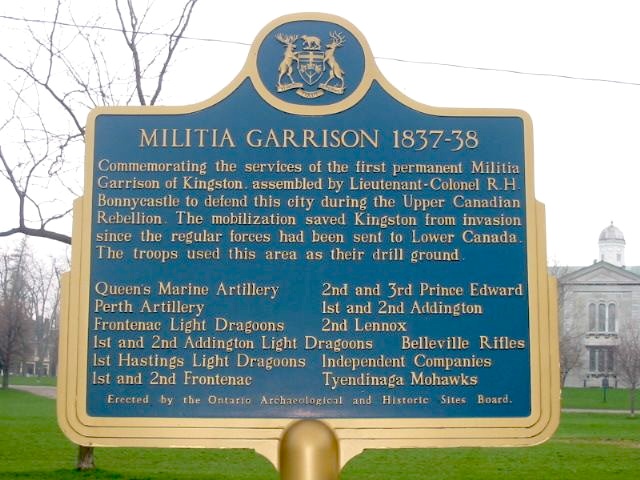
If you take a short walk south to City Park, you’ll
find a historic plaque celebrating the volunteers who saved Kingston from an
invasion during the rebellion of 1837-38. When I first saw this, I was puzzled.
Weren’t the rebellions domestic? Initially, yes. But a number of rebels fled to
the United States after their first failed uprising. The plaque does not
mention that this invasion was launched from upstate New York by Canadian
rebels, backed by American republicans, and led by a Polish revolutionary who
had been exiled following a failed uprising against the Russian Empire.
Whereas the War of 1812 celebrations have at least sparked some critical
questioning of its propagandistic intentions in the mainstream press, and led to some
fascinating interviews with researchers on CBC Radio One, such an open space is still
not allowed for more recent wars, notably the two world wars.
The two world wars are understandably central to the new
militarist national history. That’s why it’s still so dangerous to offer up
interpretations that might cast aspersions on the decisions of Canada’s
war-time politicians and generals and especially units involving thousands of rank-and-file soldiers and airmen who "just followed orders."
Consider such ridiculous cases as the new Canadian War Museum in Ottawa ceding to the demands of Air Force veterans to change the wording of a plague
describing the bombing of Dresden and other German civilian targets as war
crimes. Such a response was foreshadowed in the early 1990s with a veteran-led assault on the gripping CBC documentary series The Valour and the Horror, and specifically the episode Death by Moonlight.
Death by Moonlight: Bomber Command by Brian McKenna, National Film Board of Canada
Efforts to revisit Canadian military history are dismissed as “revisionism” as
if no reinterpretation, let alone a new interpretation based on new evidence, is valid. History, it is often claimed, is “just the facts.” That such
attitudes are so widespread is the real failure of Canadian high school history
classes, not the absence of a national narrative or the overemphasis on social
history instead of military history, as claimed by Jack Granatstein in his 1998
best-seller Who Killed Canadian History?
Dieppe: the myth-building interpretation
With all this in mind, the recent 70th
anniversary of the Dieppe Raid should give us a moment to reconsider the
mainstream nationalist and militarist interpretation of Dieppe as a tragedy with a silver-lining. Despite the ill-fated raid on the fortified French
coastal city of Dieppe on August 19 1942 by 6,000 Allied troops, mainly
Canadians, the raid provided the Allies an invaluable understanding of how to
pull-off a large-scale invasion of France. So the story goes.
This interpretation is summed up very well in a Montreal Gazette article
authored by Bernard Amyot. Amyot is not a historian, but president of the
Canadian Bar Association. What Amyot is doing writing about Dieppe is beyond
me, but his analysis of the raid is not at all different from something you would
find in mainstream military history books. Amyot also provides us with the
claim that this raid had a unifying effect for Canadians – a claim that is also
rolled out fairly commonly even if there are criticisms about the raid.
Let’s unpack the two key passages that build the myth around Dieppe:
"The lessons
learned from the mistakes of this failed landing would later help ensure the
successful liberation of Europe, and the world, from Hitler’s unparalleled Nazi
tyranny. Indeed, British Prime Minister Winston Churchill had conceived of the
Dieppe raid mainly as a “rehearsal” for the greatest and most successful
landing operations in history which were launched around Arromanches in
Normandy on June 6, 1944 (Operation Neptune), the success of which was paid for
at a terrible price by Canadian forces 70 years ago."
and
"The Dieppe raid,
though it resulted in tremendous loss for Canada, contributed to uniting
Canadians of all origins in fighting a common evil. It confirmed Canada’s role
as an independent force to be reckoned with, not only within the British
Commonwealth, but throughout the world, starting in France. It has made us a
better country, a united country that proudly vies for justice and freedom — something
we can all celebrate."
Churchill's agenda
Let’s deal with the first paragraph by knocking down the
myth of Churchill, the alleged military and political genius - a Tory who was ousted in a landslide only two months after the collapse of the Nazi regime, ushering in the most transformative, progressive British Labour government ever.
There’s always a
curious and glaring oversight when someone draws a direct line from Dieppe to Normandy. Dieppe
was not followed by the invasion of France. Italy was invaded nine months
before France on Churchill's idiotic insistence that it was the "soft
underbelly of Europe". Sicily fell very quickly and the Allies invaded
Italy at the boot and heel. But Italy’s mountainous terrain and dense towns with
narrow streets provided excellent natural defenses for the fascists and a huge
hindrance to mobility. Italy became a long, arduous and costly campaign – with worse
casualties for infantry than even the Western Front following D-Day. Success
was measured in short distances and very high losses. The Allies didn’t even
reach the more open terrain of northern Italy until a few weeks before the
general German surrender in April/May 1945.
Why is the Italian campaign important
to raise? Churchill clearly hadn't learned his lesson from the previous war
when he spearheaded the disastrous invasion of Gallipoli in which Australian,
New Zealand, French, Indian and British troops trapped on a narrow strip of
rocky land for nine months before being evacuated. Churchill’s “military”
credentials do not hold up to scrutiny. So why was he so insistent on invading
Italy – with its fascist state crumbling amidst the defeats in North Africa –
before France?
Churchill's emphasis on invading Italy first (and subsequent
special operations interventions Greece) was about maintaining British control
of the Mediterranean as well as keeping Communist influence out. When
Mussolini’s government collapsed through mid-1943, the Nazis occupied Italy and put Mussolini in charge of a northern-based puppet state. The puppet
state and the Nazi occupiers were subjected to a relentless resistance campaign
led by the Italian Communist Party, which, as the war approached an end, became
the most powerful political force in the country. Local Communist-led armed
resistance in the Nazi-occupied Balkans and Greece also helped drive out the
Nazis who were increasingly at risk of being cut off from an escape route to
Germany by advancing Soviet armies. The story after Nazi collapse in Italy and
withdrawal in Greece was the Allied disarmament of the partisans to prevent the
eradication of Nazi-sympathizing domestic elites. These domestic elites were
instrumental in British and American efforts to ensure that Italy and Greece
would not become Communist after the war.
Stalin, who headed up the Soviet bureaucracy and had finally
drowned the Russian Revolution in blood during the 1930s, sold out the
Communists in Greece in October 1944 in a secret agreement between Stalin and
Churchill. The agreement carved up British and Soviet influence over various
European countries. There is much talk of the Soviets imposing the Iron Curtain
on Europe. But this was a mutual decision by the Western allies, namely
Churchill and Roosevelt, and the Soviet Union. It was a similar process to what
happened after World War One – the carving up of Europe by the victors. It was
this carving up that did not jive with many local, Communist, nationalist
and democratic movements who had formed the backbone of the resistance across Europe. Greece was caught in this imperial tug-of-war and from 1946 to 1949, its
domestic political conflicts which did have a violent edge escalated into a
full-scale civil war in which the UK and US sponsored and armed the
anti-Communist side. In Italy, CIA operations warped the country’s fragile new
representative democratic system to prevent the Communists from winning
elections in the immediate post-war years..
Through 1943, once North Africa had been secured
by the Allies, the actual liberation of Europe from Nazi occupation and the
invasion of Germany itself to physically destroy the Nazi state (which in
itself is more complicated than we're taught), took a backburner to British
imperial and Western anti-Communist interests in the Mediterranean. Although
the Western allies did liberate Western Europe (with much help from the French
Communist-led resistance) and invade western Germany, the Soviet Union had
carried all the heavy lifting on continental Europe. On the ground, it fought the Nazis almost
single-handedly from June 1941 to June 1944, and suffered the most horrendous casualties in the
war – 27 million – casualties exacerbated by Stalin’s complete disregard for
human life.
Dieppe as a function of Western-Soviet relations
So what, exactly, was the Dieppe Raid's purpose? Let's dispense with the "rehearsal" argument.
If "rehearsal" was the primary concern, the Dieppe
Raid was not necessary. As Dieppe happened, the Americans also invaded
Guadalcanal in the Pacific. This started a three-year
"island-hopping" campaign which recaptured the vast Pacific island
network that the Japanese had established by seizing strategic islands (such as those with airports) while skipping over other islands to cut the supply lines to their Japanese garrisons. The necessary experience in amphibious
landings that translated to the invasion of France came not from Dieppe or the
unopposed landings in Algeria or Sicily, but the American island-hopping
campaign in the Pacific which was nearly two years old as of D-Day.
The first of two major reasons why Dieppe happened was to allay the Soviet Union which was demanding the Allies open up a second front
in Western Europe to take some of the pressure off fighting almost the entire
Nazi war machine. To put matters in perspective, the Western Allies were only
fighting at most 140,000 German troops in North Africa between 1940-43. From
the invasion of Russia in June 1941 onward, Germany never had fewer than two
million soldiers on the Eastern Front. This is one reason why the German
general, Erwin Rommel, who commanded the German Afrika Korps, was constantly
asking Hitler for more troops. Hitler treated North Africa as a sideshow
whereas Rommel and other German commanders saw the seizing of the Suez Canal as
strategically important. Despite the early victories in Russia, a deep
undercurrent of opposition to Hitler emerged because of the invasion. German military commanders
were not ignorant of Napolean’s campaign in Russia and its role in shattering the continent-wide empire and satellite states he had established. Rommel, the most celebrated
German general of the war and an obvious military genius (unlike Churchill or
Montgomery) would then join the efforts by a group of officers to assassinate Hitler.
He was implicated and committed suicide in October 1944 rather than go to
court.
The scale of the Eastern Front cannot be understated. It was indisputably the front upon which the entire European conflagration orbited. Even the Italians had more
troops and far higher losses on the Eastern Front between 1941 and 1943 than
during the North Africa campaign against the Commonwealth armies. When Dieppe
happened, the Nazis were at the edge of Moscow and the Battle of Stalingrad had
not even started, let alone reached its turning point. It wasn’t until November
1942 that the German armies in Stalingrad were surrounded and another three
months before they surrendered. This is the military-political context for the Soviets
demanding the Western allies open up a second front. Dieppe, in this sense, was
a bloody PR stunt for Stalin.
Dieppe and the Canadian home front
For Canadians, the Dieppe Raid was also
about placating an increasingly agitated domestic population. The fall of France happened in June
1940. Canadian troops had been stationed in England since late 1939 and had not
seen any action. The public was growing impatient as war raged across North Africa as the only front being fought by the Commonwealth armies in the Western hemisphere. Political decisions had been made to keep Canadian troops
together, so they were never committed piecemeal to North Africa like the Australians and New Zealanders had done. By mid-1942, almost four entire Canadian divisions were in England – upwards
of 80,000 combat troops. There were thousands more Canadians in England, many
of them engaged in the air war, including those in the Sixth (Canadian) Bomber
Group in Britain’s Bomber Command who carried out the strategy of Air Marshal
Sir Arthur “Bomber” Harris. This strategy was to bomb German civilians targets
– and it killed 600,000 German civilians over five years, including 60,000 in
Dresden during its infamous firebombing. The extent of the Canadian contribution to the air war is reflected in Canadian casualties. Of the 47,000 Canadian war deaths, 18,000 were of those were members of the Royal Canadian Air Force.
By 1942, two years had passed with no prospect of a second
front opening up and the Soviet Union doing all the major fighting. Sympathy in the West, including Canada,
for the Soviet Union ran very high. It was not only promoted by the mainstream
press and government as a key ally, but the it was still seen by many as a
progressive alternative system. Not only did the Communists play a major role in the rising labour movement, and had an MLA elected in Manitoba in 1941, two MPPs elected in downtown Toronto in 1943, and an MP, Fred Rose, elected in a Montreal by-election in 1945.
Labour tensions were also beginning to boil over amidst a regime of strict rationing and a
government-enforced culture of suspicion that ranged from the innocuous “loose
lips sink ships” rhetoric to the geographic dispersal and internment of
Japanese-Canadians and theft of their property. While the home front's popular commitment to the war effort cannot be denied, it was interwoven with a series of deep-seated social grievances, many of which had arose before the war in the depression. At times, these grievances expressed themselves forcefully, explosively.
It’s worth looking at Canada's labour situation in the months leading up to
Dieppe. In the middle of wartime austerity and the war itself not going well, labour tensions had exploded over the Kirkland Lake goldminers strike of late 1941 and early 1942. After a few years of relative labour peace - partially enforced by the no-strike pledge of the Communist Party on the grounds that strikes would sabotage the war effort with our Soviet allies - the workers movement across the
country was mobilized against federal and provincial government-backed
repression of union rights at Kirkland Lake. While the strike went down to defeat, it galvanized a new workers movement that would escalate its struggle through the 1940s and force the government to codify a system of tripartite industrial relations involving unions, employers and the state.
Other political tensions also rose rapidly. In April 1942,
the federal government held a plebiscite on conscription in which Prime
Minister King sought popular support to flip-flop on his anti-conscription
promises made at the outset of the war. Only 25 years earlier, a conscription
crisis had gripped Canada and in Quebec, the memory of anti-conscription being
shot dead in Quebec City’s streets by Anglophone soldiers was not forgotten. Conscription,
even with the plebiscite passing, fuelled significant anger in Quebec. While 83 percent of Anglophones voted in favour of conscription, over 70 percent of Francophones opposed it.
This political opposition to hardship on the home front and lack of progress on
the war front was confirmed in a 1942 Gallup poll showing the CCF ahead of both
the Liberals and Conservatives with a plurality of overseas soldiers supporting
the CCF. This marked a serious and sustained effort by the ruling Liberals of Mackenzie King to begin taking very seriously the need for implementing social reforms to diffuse popular anger and prevent social upheavals like what happened between 1917 and 1919.
 |
Saskatchewan Liberal Party
anti-CCF poster, c.1938. Source |
It was this discontent that played a massive role in informing the Canadian
government's decision to commit troops to the Dieppe Raid as well as to the invasion of Sicily in September
1943, thus dividing up the Canadian Corps. These domestic divisions and tensions continued
through the war, reflected most forcefully in the radicalization and ballooning of a new workers movement alongside a strong Communist Party and most acutely, a huge swing of support behind the still young socialist party, the Cooperative Commonwealth Federation. The CCF became the opposition in BC in 1942, narrowly lost the Ontario election in 1943 and took power in Saskatchewan in 1944. Political polarization was such that Canada witnessed its government and business-initiated Red Scare
reach full-steam after the war even before the Americans, amidst one of the most extensive strike waves in Canadian history.
To conclude, let's not make Dieppe something it is not. It
did not unite Canadians except in grief. It was a waste of life designed to
recover lost political support at home and throw a bone to the Soviet Union. It
is not something to celebrate.